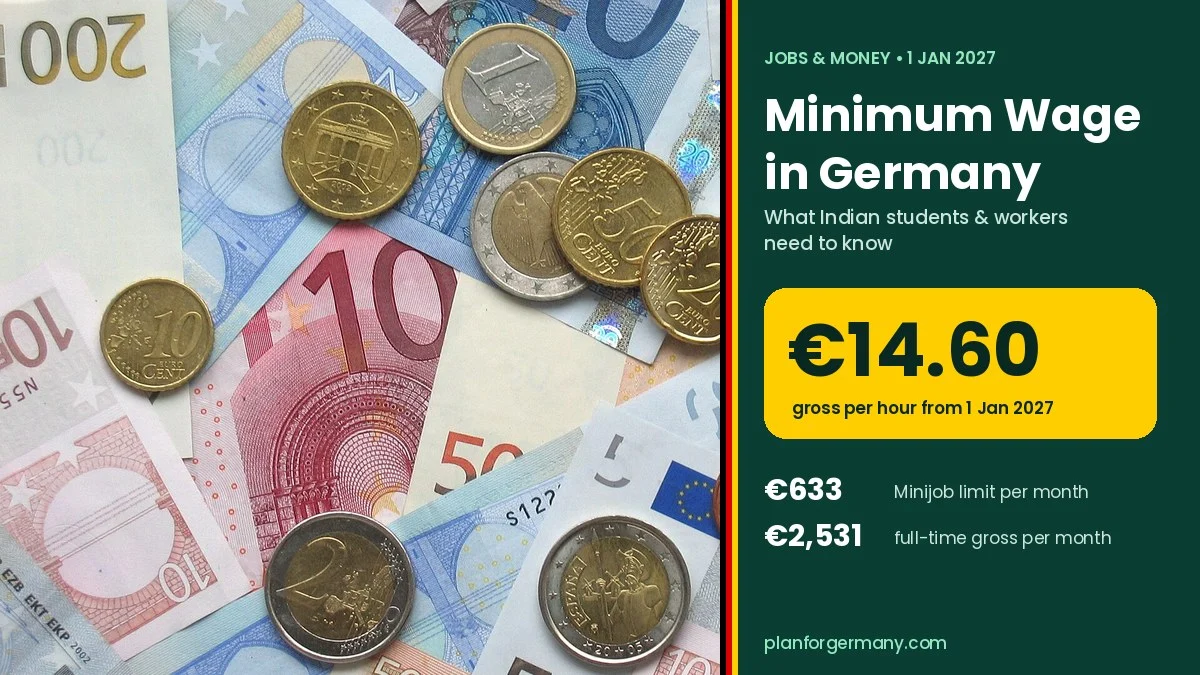
The Minimum Wage in Germany rises to €14.60 gross per hour on 1 January 2027, up from €13.90 today. That 70-cent jump is the second step of the biggest increase since the wage floor was introduced in 2015, and it changes the numbers behind every student job, Minijob and entry-level contract in the country.
If you are an Indian student planning to work alongside your studies, a job seeker on the Opportunity Card, or a newcomer comparing your first offer, you need to know exactly what the new rate means for you. This guide explains the 2027 rate, who is covered and who is not, the new €633 Minijob limit, student working-hour rules, sector minimum wages, and how to check your payslip.
Table of Contents
Minimum Wage in Germany 2027: Key Facts at a Glance
- From 1 January 2027: €14.60 gross per hour (2026: €13.90; 2025: €12.82)
- Full-time equivalent: about €2,531 gross per month at 40 hours a week
- Minijob limit 2027: €633 per month (€7,596 per year), up from €603
- Midijob range 2027: €633.01 to €2,000 per month with reduced employee social contributions
- Who it covers: all employees in Germany aged 18+, regardless of nationality, including Minijobbers and international students
- Main exceptions: apprentices (separate floor of €764 in year one), mandatory internships, orientation internships up to 3 months, under-18s without vocational training
- Enforcement: customs (Finanzkontrolle Schwarzarbeit); fines of up to €500,000 for underpayment
Minimum Wage in Germany 2027: The New Rate
The rate is fixed by law. The Fifth Minimum Wage Adjustment Ordinance (MiLoV5), signed on 5 November 2025, set two steps in one go: €13.90 from 1 January 2026 and €14.60 from 1 January 2027. The government adopted the recommendation of the independent Minimum Wage Commission, made up of employer and union representatives plus academic advisers, from 27 June 2025.
No new decision is needed, so the increase is certain. Over the two years, the minimum wage in Germany rises by 13.9%, or €1.78 per hour, compared with 2025. The German Trade Union Confederation (DGB) estimates that around 6 million workers benefit, mostly in retail, logistics, hospitality and cleaning.
How the Rate Has Developed Since 2015
| Year | Hourly minimum wage (gross) | Note |
|---|---|---|
| 2015 | €8.50 | Statutory minimum wage introduced |
| 2020 | €9.35 | |
| Oct 2022 | €12.00 | One-off increase by law |
| 2024 | €12.41 | |
| 2025 | €12.82 | |
| 2026 | €13.90 | First step of MiLoV5 |
| 2027 | €14.60 | Second step of MiLoV5 |
The Commission reviews the rate every two years, so the next change after 2027 will be decided in 2027 for the years that follow.
What €14.60 Means per Month and per Year
Your monthly pay depends on your hours. Payroll offices use an average of 4.33 weeks per month (52 weeks ÷ 12). Here is what the minimum wage in Germany adds up to for typical working patterns in 2027:
| Working pattern | Hours per month (approx.) | Gross pay per month at €14.60 |
|---|---|---|
| Minijob (about 10 hours/week) | 43.3 | €633 (the Minijob cap) |
| Working student (20 hours/week) | 86.7 | about €1,265 |
| Part-time (30 hours/week) | 130 | about €1,898 |
| Full-time (40 hours/week) | 173.3 | about €2,531 |
These are gross figures. Income tax, solidarity surcharge (rarely for low incomes), and social security contributions for health, care, pension and unemployment insurance are deducted from them. How much you take home depends on your tax class, church membership and health insurer; our guide to German tax classes explains the system, and our health insurance guide shows what the contributions look like.
A full-time job at the minimum wage in Germany comes to roughly €30,370 gross a year. That pays the bills in many smaller cities, but it is tight in Munich, Frankfurt or Hamburg, where rent alone can eat half your net pay. Compare it with typical budgets in our article on the cost of living in Germany before you accept an offer.
Who Is Entitled to the Minimum Wage in Germany?
According to the Federal Ministry of Labour (BMAS), the minimum wage in Germany applies to all employees working in the country, regardless of how many hours they work and regardless of nationality. It also applies if your employer is based abroad, as long as you work in Germany. For Indian readers, this means:
- International students in part-time jobs, Minijobs and working-student roles are covered.
- Opportunity Card holders doing part-time work (up to 20 hours a week) or trial work are covered.
- Seasonal workers are covered; only for them can board and lodging be partly offset.
- Spouses and family members who start working in Germany are covered from day one.
- Overtime counts: you are entitled to the minimum wage for every hour you actually work.
Exceptions: Who Does Not Get the Minimum Wage
The law has a short list of exceptions. Check these carefully, because many international students fall into the internship categories:
| Group | Gets the statutory minimum wage? | What applies instead |
|---|---|---|
| Apprentices (Azubis) | No | Minimum training allowance: €764 (1st year), €902, €1,031, €1,070 in 2027 |
| Mandatory internship (Pflichtpraktikum) required by your degree | No | Whatever the company offers; often unpaid or a small stipend |
| Voluntary internship up to 3 months for orientation or alongside studies | No | Company stipend |
| Voluntary internship after graduation or longer than 3 months | Yes | €14.60 per hour from 2027 |
| Under 18 without completed vocational training | No | No legal floor |
| Long-term unemployed (first 6 months of a new job) | No | Contract wage |
| Volunteering (Ehrenamt) | No | Not employment |
If you are thinking about vocational training instead of a degree, our Ausbildung in Germany guide explains the training allowance and the § 16a visa route in detail.
Minimum Wage in Germany for Students: Minijob, Werkstudent & Day Limits
Most Indian students meet the minimum wage in Germany through a side job. Two separate rule sets matter here: the immigration rules that limit how much you may work, and the social security rules that decide how your job is classified.
The 140-Day Rule for Non-EU Students
As the DAAD explains on its side-jobs page, students from outside the EU may work 140 full days or 280 half days per year without extra permission. Student assistant jobs (HiWi) at a university are exempt from this limit, but you must still inform the foreigners’ office. Working more needs approval from the Ausländerbehörde and the Federal Employment Agency. Breaking these rules can cost you your residence permit, so track your days carefully.
Minijob Rules in 2027
Because the Minijob limit is tied to the minimum wage (10 hours a week × minimum wage × 13 ÷ 3, rounded), it rises automatically to €633 per month, or €7,596 per year. At exactly €14.60 per hour you can still work about 43 hours a month. If you earn more per hour, your hours shrink accordingly.
- Minijobbers pay no income tax and usually only a small pension contribution, from which you can opt out.
- You may exceed the limit in up to two months a year if it was unforeseeable, for example covering a sick colleague.
- Watch out: if you worked exactly €603 in 2026 at €13.90, the same hours at €14.60 give about €633.35, slightly over the new cap. Your employer should trim your hours a little from January.
- Your employer must record the start, end and duration of your working time for every Minijob, except in private households.
Working Student (Werkstudent) Jobs
Working-student jobs are usually better paid than the minimum wage in Germany, especially in IT, engineering and consulting, and they build your CV. The 20-hour-per-week rule during lectures keeps you in the cheap student insurance; read our full working student guide for the tax and insurance rules. If you aim for an engineering role after graduation, see where demand is strongest in our guide to engineering jobs in Germany.
Can a Side Job Cover Your Living Costs?
Not fully. For the student visa, Germany expects proof of €11,904 a year (€992 a month) in a blocked account. A Minijob paying €633 a month covers less than two-thirds of that. Treat your job as a top-up, not your main source of funds, and plan rent with our apartment hunting tips. For a full picture of student life, read life in Germany for students.
Sector Minimum Wages Above €14.60
Some industries have their own, higher wage floors, negotiated by unions and employers and declared binding by the government. In these sectors, the minimum wage in Germany is only the absolute floor and the sector rate applies. The most relevant example for Indian applicants is elderly care (Altenpflege), a major recruiting field for nurses from India:
| Care sector role (ambulatory and residential care) | From 1 July 2026 | From 1 July 2027 |
|---|---|---|
| Care assistants (Pflegehilfskräfte) | €16.52 | €16.95 |
| Qualified assistants (at least 1 year of training) | €17.80 | €18.26 |
| Registered nurses (Pflegefachkräfte) | €21.03 | €21.58 |
The figures come from the 7th Care Working Conditions Ordinance. Hospitals are not covered by it, but most hospital nurses are paid under collective agreements that are higher anyway. Other sectors with their own floors include electrical trades, building cleaning and temporary agency work; ask your employer which collective agreement (Tarifvertrag) applies to your contract.
Minimum Wage vs. Visa Salary Requirements
A common mistake is to assume that a job paying the minimum wage in Germany is enough for a work visa. It usually is not. Skilled-worker visas have their own pay rules:
| Residence title | Salary rule | Is minimum wage enough? |
|---|---|---|
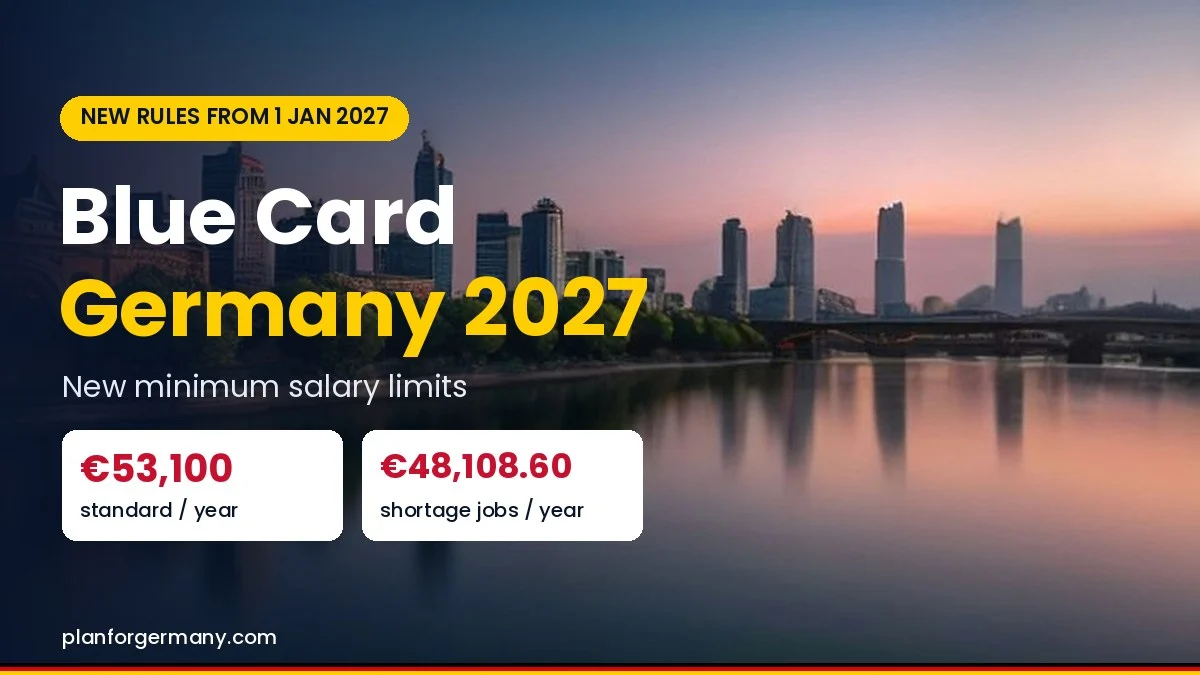
| EU Blue Card (shortage occupations, new graduates) | €45,934.20 a year in 2026; €48,108.60 planned for 2027 | No |
| EU Blue Card (other occupations) | €50,700 in 2026; €53,100 planned for 2027 | No |
| Skilled worker visa (§ 18a/18b) | Pay must match German colleagues in the same job; higher floor if you are 45+ | Rarely |
| Opportunity Card | Proof of funds; part-time work up to 20 hours/week allowed | Yes, for side jobs |
| Student visa | Blocked account €11,904 a year | Side jobs only |
For the exact Blue Card numbers and what changes on 1 January 2027, read our Blue Card Germany 2027 guide. If you want to come to Germany first and look for work on the spot, the Opportunity Card lets you earn money part-time while you search.
How to Check You Are Paid the Minimum Wage in Germany
Underpayment happens most often in Minijobs, delivery work, cleaning, restaurants and warehouses, and newcomers are easy targets because they do not know the rules. Use this checklist from your first payslip:
- Get a written contract or at least written confirmation of your hourly rate and hours.
- Keep your own record of start time, end time and breaks every day (a phone note is enough).
- Divide your gross monthly pay by the hours you actually worked, including overtime. The result must be at least €14.60 from January 2027.
- Know what counts: shift and Sunday allowances can be offset against the minimum wage; statutory night-work supplements cannot.
- Payment is due at the latest on the last bank working day of the month after the month you worked.
- Your employer cannot pay you in kind (food, housing) instead of money, except in narrow limits for seasonal workers.
- Make sure you are registered at your address; you need your tax ID from the Anmeldung for payroll.
What to Do If Your Employer Pays Less
- Raise it in writing with your employer first, quoting the hourly rate and hours worked.
- Call the BMAS minimum wage hotline: 030 60 28 00 28 (Monday to Thursday 8:00–17:00, Friday 8:00–12:00).
- Report to customs: the Finanzkontrolle Schwarzarbeit (FKS) at your local main customs office checks employers; tips can be anonymous.
- Claim back pay: you can sue for the difference at the labour court; union members get free legal advice and representation.
- Ask for help: your university’s International Office or student union can point you to free counselling.
Employers face fines of up to €500,000 for failing to pay the minimum wage and up to €30,000 for failing to record working time, so a well-documented complaint is taken seriously.
Minimum Wage in Germany: Checklist for January 2027
- ☐ Check your hourly rate on the January 2027 payslip: at least €14.60 gross
- ☐ Minijob: make sure your monthly pay stays at or below €633
- ☐ Student on a visa: count your working days (140 full / 280 half days a year)
- ☐ Internship: find out whether it is mandatory (no minimum wage) or voluntary over 3 months (minimum wage applies)
- ☐ Care job: compare your pay with the sector minimum (€16.52 to €21.03 per hour)
- ☐ Keep your own time records and all payslips for at least three years
What is the minimum wage in Germany in 2027?
From 1 January 2027, the statutory minimum wage in Germany is €14.60 gross per hour, up from €13.90 in 2026. At 40 hours a week, this equals about €2,531 gross per month.
Do international students get the minimum wage in Germany?
Yes. The minimum wage applies to all employees in Germany regardless of nationality, including international students in Minijobs and part-time jobs. Only mandatory internships and short voluntary internships of up to three months are exempt.
How much can I earn in a Minijob in 2027?
The Minijob limit rises to €633 per month (€7,596 per year) on 1 January 2027. At the minimum wage this allows about 43 hours of work a month.
Do apprentices get the minimum wage?
No. Apprentices receive a separate minimum training allowance. In 2027 it is €764 a month in the first year, rising to €902, €1,031 and €1,070 in later years.
How many days can Indian students work in Germany?
Non-EU students may work 140 full days or 280 half days per year without extra permission. Student assistant jobs at the university are exempt from this limit, but the foreigners’ office must be informed.
Is a minimum wage job enough for a German work visa?
Usually not. The EU Blue Card needs at least €45,934.20 a year in 2026 for shortage occupations, and skilled-worker visas require pay comparable to German colleagues. Minimum wage jobs are mainly relevant for students and Opportunity Card holders.
Conclusion
The Minimum Wage in Germany reaches €14.60 per hour on 1 January 2027, the Minijob limit moves to €633, and nearly every student and entry-level job is affected. For Indian students and newcomers, the rule is simple: know your hourly rate, track your hours, respect the 140-day limit, and do not rely on a side job to replace your blocked account.
If your goal is a long-term career, use part-time work as a stepping stone towards a working-student role and, later, a skilled job that clears the Blue Card threshold. Bookmark this guide and check the official BMAS pages before you sign any contract.
Featured image based on the photo “Euro coins and banknotes” by Avij, public domain, via Wikimedia Commons (cropped, text added).