

The Opportunity Card Germany (Chancenkarte) is one of the easiest ways for non-EU professionals to move to Germany before they have a job offer. It lets you live in Germany for up to one year, look for skilled work, and earn money with a part-time job while you search.
Since its launch on 1 June 2024, German missions issued more than 19,000 Chancenkarte visas by the end of 2025, and demand is still rising in 2026. In this guide, we explain the points system, the money you need, the documents, and the exact steps to apply, with a free checklist at the end.
Table of Contents
Opportunity Card Germany: Key Facts for 2026
- Legal basis: Section 20a of the German Residence Act (AufenthG)
- Who can apply: non-EU/EFTA nationals with a degree or at least two years of vocational training
- Points needed: 6 points (only if your qualification is not fully recognised)
- Language: German A1 or English B2 as a minimum (points route)
- Money needed in 2026: €1,091 per month, or €13,092 for 12 months
- Validity: up to 12 months for the job search
- Work allowed: up to 20 hours a week plus trial work of up to two weeks per employer
- Visa fee: €75 (national visa fee)
What Is the Opportunity Card Germany?
The Opportunity Card, called Chancenkarte in German, is a residence title for job seekers. It was introduced as part of Germany’s reformed skilled immigration law to help employers fill open positions faster.
Unlike a regular work visa, you do not need a job contract to apply. You come to Germany first, attend interviews in person, network, and then switch to a work residence permit once you find a suitable job.
This makes the Opportunity Card Germany very attractive for engineers, IT specialists, nurses, technicians and other professionals from India and other non-EU countries. If you already have a job offer, a classic work visa is usually the better route. Read our guide on the Germany work visa application process for that path.
Two Ways to Qualify for the Chancenkarte
There are two separate routes to the Opportunity Card Germany. Which one applies to you depends on whether your qualification is fully recognised in Germany.
Route 1: Skilled Worker With a Recognised Qualification
If your foreign degree or vocational qualification is fully recognised in Germany, or if you earned it in Germany, you count as a skilled worker (Fachkraft). In that case you can get the Opportunity Card Germany without any points.
You also do not need to prove language skills on this route, although German will clearly help you find a job faster.
Route 2: The Chancenkarte Points System
If your qualification is not fully recognised, you can still qualify through the points system. For this route you must meet three basic conditions first:
- A completed university degree, or vocational training of at least two years, that is recognised by the state where you earned it
- German language skills of at least A1, or English skills of at least B2 (CEFR)
- At least 6 points in the points table below
For university degrees, you show recognition with a positive entry in the anabin database or a Statement of Comparability (Zeugnisbewertung). For vocational training, you need a positive Digital Statement on Professional Qualification.
Opportunity Card Germany Points Table 2026
Here is the full points system as published on the official Make it in Germany portal. You need a total of 6 points to qualify for the Opportunity Card Germany through the points route.
| Criterion | What you need | Points |
|---|---|---|
| Partial recognition | Your qualification has been found partially equivalent (or you need compensation measures in a regulated profession) | 4 |
| Professional experience | At least 5 years in the last 7 years | 3 |
| Professional experience | At least 2 years in the last 5 years | 2 |
| German language | B2 or higher | 3 |
| German language | B1 | 2 |
| German language | A2 | 1 |
| English language | C1 or higher, or native speaker | 1 |
| Age | Up to 35 years | 2 |
| Age | Over 35 and up to 40 years | 1 |
| Shortage occupation | Your qualification is in a shortage occupation | 1 |
| Previous stay in Germany | At least 6 months of legal stay in the last 5 years (not tourism) | 1 |
| Partner | Your spouse or partner also qualifies for an Opportunity Card | 1 |
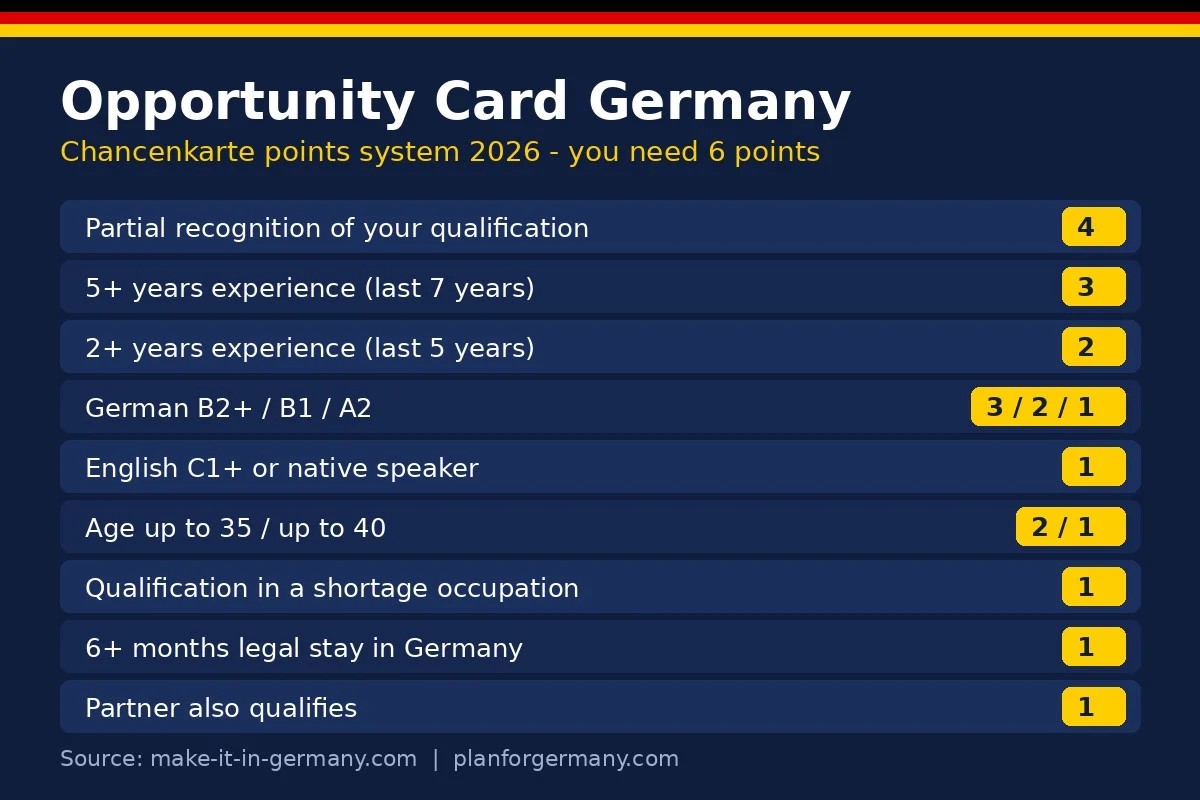
Professional experience only counts if it relates to your qualification and was gained after you graduated. Every point must be backed by documents, such as certificates, experience letters and old passport stamps.
Example: How Priya Scores 7 Points
Priya is a 29-year-old software engineer from Pune. She has a bachelor’s degree listed as recognised in anabin, four years of work experience and German at A2 level. Her score looks like this:
- Age under 35: 2 points
- At least 2 years of experience in the last 5 years: 2 points
- German A2: 1 point
- IT is a shortage occupation: 1 point
- English C1 (IELTS 7.5): 1 point
Total: 7 points. Priya clears the 6-point bar, and she also meets the basic language rule thanks to her German A1+ level.
Tip: Before you pay for anything, run the free Opportunity Card self-check on Make it in Germany. It tells you in a few minutes whether you are likely to qualify.
Financial Requirements and Cost of the Opportunity Card Germany
You must prove that you can pay for your stay while you look for work. For 2026, the official figure is €1,091 per month. For a full 12-month card, that adds up to €13,092.
You can prove the money in one of these ways:
- A blocked account (Sperrkonto). See our step-by-step guide on how to open a blocked account with Fintiba
- A declaration of commitment (Verpflichtungserklärung) signed by a sponsor living in Germany
- A part-time employment contract in Germany, accepted by some missions in combination with other funds
Besides the blocked account, plan for these typical costs:
| Cost item | Typical amount |
|---|---|
| Visa fee (national visa) | €75 |
| Proof of funds for 12 months (2026) | €13,092 |
| Travel health insurance | Minimum cover €30,000, price depends on provider |
| Anabin or Statement of Comparability | Varies, check the official fee before applying |
| Translations and certified copies | Varies by country and number of documents |
Remember that €1,091 is a minimum. Rent in cities like Munich, Frankfurt or Berlin can take a big share of that. Check our detailed article on the cost of living in Germany to plan a realistic budget.
Documents Checklist for the Chancenkarte Application
Each German embassy or consulate publishes its own list, so always check your local mission’s website. Most lists for the Opportunity Card Germany include these documents:
- Valid passport (issued within the last 10 years, valid for the whole stay) plus copies
- Completed national visa application form, printed and signed
- Recent biometric passport photo (35 x 45 mm)
- Degree certificate and transcripts, plus anabin printout or Statement of Comparability
- Recognition notice, if you apply via Route 1 or claim the 4 points for partial recognition
- Language certificates (German A1+ or English B2+)
- Experience letters and proof of employment for the experience points
- Proof of financial means (blocked account confirmation or declaration of commitment)
- Travel health insurance covering at least €30,000 for the first part of your stay
- A cover letter explaining your job search plan, target roles and where you will live
- CV in a German or Europass format
A clear cover letter matters more than many applicants think. Show that you researched the job market, name the regions and job titles you are targeting, and add any contact with recruiters.
How to Apply for the Opportunity Card Germany Step by Step
- Check your eligibility. Decide whether you use Route 1 (recognised qualification) or Route 2 (points).
- Collect your documents. Get anabin results, language certificates and experience letters ready first, because they take the longest.
- Set up your proof of funds. Open and fund your blocked account, then download the confirmation.
- Apply online. Most missions now accept Chancenkarte applications through the Consular Services Portal of the Federal Foreign Office. Some, like the embassy in London, accept them only online.
- Book and attend your appointment. Show the originals, give your fingerprints and pay the €75 fee. Our guide on booking a Germany visa appointment explains the process.
- Wait for the decision. Processing times for the Opportunity Card Germany vary a lot by country, from a few weeks to several months in high-demand locations like India.
Life in Germany With a Chancenkarte
Once you arrive on your Opportunity Card Germany visa, a few tasks come first. Register your address within two weeks at the local Bürgeramt. Our guide on the Anmeldung (city registration) shows you how.
Next, sort out health insurance for the longer term. Travel insurance usually covers only the start of your stay, so read our overview of public health insurance in Germany before your cover ends.
Working Part-Time on the Opportunity Card
While you search for skilled work, you may take part-time jobs of up to 20 hours a week on average. You can also do trial work of up to two weeks per employer, as long as it is aimed at qualified employment, an apprenticeship or a recognition measure.
A 2026 change to the law made it clear that these are the only types of work allowed on the card. Full-time work in an unrelated job is not permitted.
Finding a Job Faster
- Use German job portals such as the Federal Employment Agency’s job board, StepStone and LinkedIn
- Adapt your CV to German standards, with a photo optional and a clear skills section
- Attend job fairs and meetups in your field; in-person networking is the big advantage of being in Germany
- Keep improving your German. Even basic everyday German phrases make interviews and daily life easier
For a broader plan, see our guide on the steps to getting a job in Germany.
What Happens After You Find a Job?
When you get a job offer while holding the Opportunity Card Germany, you apply at the local foreigners authority (Ausländerbehörde) to switch to a suitable residence permit, such as the EU Blue Card or a skilled worker permit. Each has its own salary rules; our article on minimum salary requirements for non-EU nationals explains them.
If your job counts as qualified employment but you do not yet meet the conditions of another residence title, the card can be extended as a follow-up Opportunity Card (Folge-Chancenkarte) for up to two years.
Common Mistakes to Avoid
Many Opportunity Card Germany applications are delayed or refused because of small, avoidable errors. Watch out for these:
- Counting experience gained before graduation; it does not earn points
- Submitting language certificates below A1 German or B2 English
- Forgetting that every point needs written proof
- Underfunding the blocked account below the 2026 amount
- Applying without a cover letter or with a vague job search plan
- Assuming the card allows full-time work in any job
Is the Opportunity Card Germany Right for You?
The Opportunity Card Germany suits you if you are a qualified professional without a job offer yet, you have savings of around €13,000, and you are ready to search actively on the ground. It is less useful if you already hold a German job offer, because a direct work visa is faster.
Government figures show that thousands of card holders have already moved on to work permits or vocational training, so the route works when you prepare well.
Frequently Asked Questions About the Opportunity Card Germany
How many points do I need for the Opportunity Card Germany?
You need at least 6 points if you apply through the points system. If your qualification is fully recognised in Germany, you do not need any points.
How much money do I need for the Chancenkarte in 2026?
In 2026 you must prove at least €1,091 per month. For a 12-month card, that means €13,092, usually shown with a blocked account or a declaration of commitment.
Can I work while holding an Opportunity Card?
Yes. You may work part-time for up to 20 hours a week on average and do trial work of up to two weeks per employer while you look for a skilled job.
Do I need to speak German for the Chancenkarte?
On the points route you need at least German A1 or English B2. On the skilled worker route no language certificate is required, but German improves your job chances.
How long is the Opportunity Card valid?
The job search card is issued for up to one year. If you find qualified work but cannot yet get another permit, a follow-up card can be issued for up to two years.
Can I apply for the Opportunity Card Germany from India?
Yes. Indian citizens apply through the German mission responsible for their state, usually via the Consular Services Portal, followed by an in-person appointment.
Conclusion
The Opportunity Card Germany gives skilled non-EU professionals a real chance to move first and find a job on the spot. Check your points honestly, prepare your €13,092 proof of funds, and build a strong cover letter.
Bookmark this guide, run the official self-check, and start collecting your documents today. For the latest rules, always confirm with Make it in Germany and your local German mission before you apply.


