
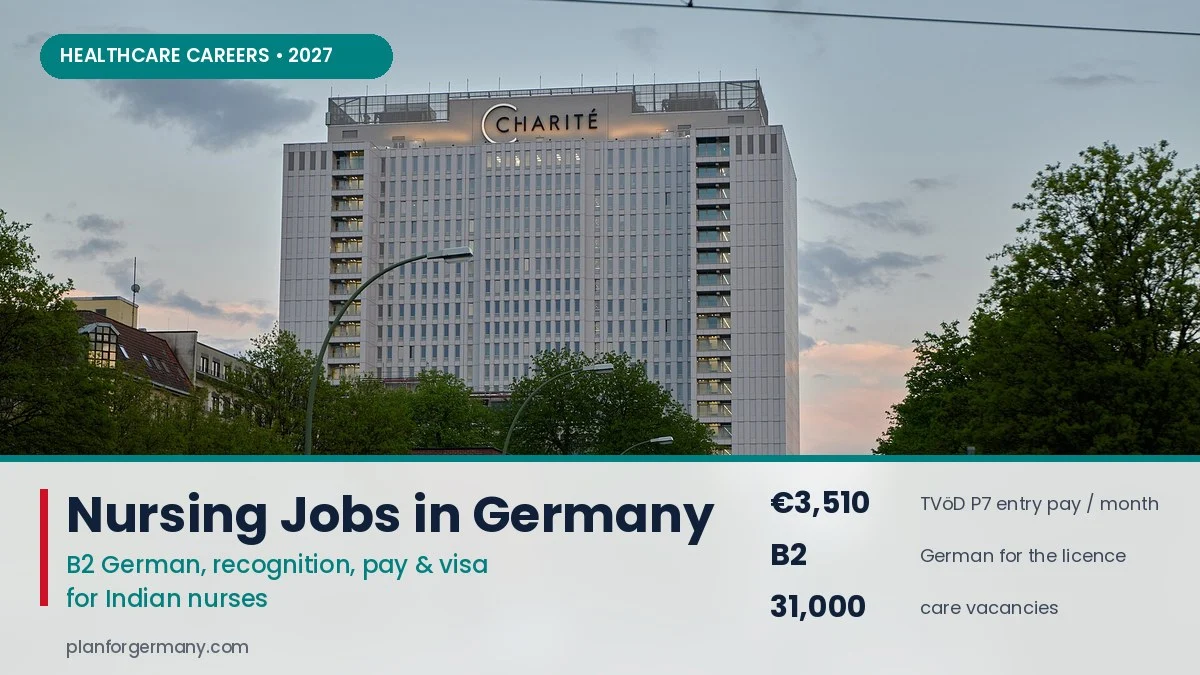
Nursing Jobs in Germany are one of the clearest routes for Indian nurses to build a career abroad, and the door is opening wider for 2027. On 11 November 2026, Germany’s BG Kliniken hospital group, the development agency GIZ and a Kerala nursing college signed a new training partnership, backed by the Federal Ministry of Labour.
A few days later, the German Consul General in Chennai said employers increasingly look to India not only for engineers and IT specialists but also for nurses. Yet the path has firm rules: B2 German, official recognition of your degree, the right visa and an employer you can trust. This guide explains each step, what nurses really earn under the public-sector pay scale, and how to avoid recruitment scams.
Nursing Jobs in Germany 2027: Key Facts at a Glance
- Demand: about 1.8 million people work in nursing jobs with social insurance, 20% of them foreign nationals; around 31,000 posts in care facilities are vacant (Make it in Germany)
- Job title: Pflegefachfrau / Pflegefachmann / Pflegefachperson — a regulated profession that needs a state licence
- German level: B2 for the licence; Triple Win asks for at least B1 when you apply for the visa
- Pay (TVöD-P, from 1 May 2026): €3,510.30 gross a month in group P7, step 2, rising to €4,305.40 in step 6
- Recognition: equivalence check by the state authority; gaps are closed by a knowledge test or an adaptation course
- Visa routes: skilled-worker permit after recognition, § 16d recognition visa, recognition partnership or Ausbildung
- No EU Blue Card: the Blue Card does not apply to nursing professionals
Table of Contents
Why Nursing Jobs in Germany Are in Demand
Germany’s population is ageing, people live longer, and fewer young Germans start a career in care. The result is steady demand for nursing jobs in Germany in hospitals, nursing homes, home-care services, rehabilitation clinics and palliative care. According to the federal portal Make it in Germany, around 1.8 million people are employed in the nursing sector in jobs subject to social insurance, and one in five of them is a foreign national. About 31,000 positions in care facilities are vacant.
Deutsche Welle reported on 27 November 2026 that the number of Indians in jobs subject to social security in Germany has grown sevenfold over the past decade to more than 140,000, with many working in IT and health care.
What Is New for Indian Nurses in 2026–27
- Kerala nursing partnership (11 Nov 2026): BG Kliniken, GIZ and Sree Gokulam Nursing College signed an MoU. 25 nursing students get German lessons, intercultural training and extra practice in elderly care, and are due to work at BG Kliniken in Berlin and Hamburg from 2029.
- Skilled-worker push from India: on 26 November 2026, the Consul General in Chennai named Tamil Nadu and Telangana as key sources of skilled workers, including nurses.
- New nursing-assistant training from 1 January 2027: the federal Nursing Assistant Act creates one nationwide 18-month training (full time) for Pflegefachassistenz.
- Faster processing in some states: Hesse’s new central office for skilled immigration takes over the fast-track procedure statewide from 1 December 2026 and aims to decide within about eight weeks.
None of this lowers the core rules for nursing jobs in Germany, though.
Requirements for Nursing Jobs in Germany
Nursing is a regulated profession in Germany. To work as a fully qualified nurse, you need a state licence to use the professional title (Erlaubnis zum Führen der Berufsbezeichnung). The authorities check four things:
| Requirement | What it means for you | Typical proof |
|---|---|---|
| Equivalent qualification | Your Indian GNM or B.Sc. Nursing must match the German nursing training | Diploma, transcripts, syllabus, registration certificate |
| German language | At least B2 (CEFR); a nursing-specific language exam may be required | Goethe, telc, ÖSD or a recognised B2 certificate |
| Health | Physically and mentally fit to work as a nurse | Medical certificate |
| Trustworthiness | No relevant criminal record | Police clearance or German certificate of conduct |
The good news: in many states you can file the recognition application before you have the B2 certificate, medical certificate and police clearance. These proofs are usually needed only at the end of the procedure.
Which Indian Nursing Qualifications Count?
For the government Triple Win programme, the Federal Employment Agency accepts a Diploma in General Nursing & Midwifery (GNM), a B.Sc. Nursing (Basic) or an Indian Nurse Registration Certificate from an accredited institution. ANM or auxiliary certificates alone usually do not lead to the full nurse licence, but they may open nursing-assistant roles.
German Language Rules for Nurses
Language is the biggest hurdle for nursing jobs in Germany. Triple Win requires at least B1 German when you apply for the visa, and its courses in Thiruvananthapuram take candidates from A1 to B1. For the full licence you then need B2. Plan for 9–12 months of serious study and practise care vocabulary early; handovers and documentation happen in German.
Recognition of Your Nursing Degree, Step by Step
Unlike engineers, who often rely on anabin and ZAB, nurses apply to the health authority of the federal state where they will work. The federal Recognition in Germany portal shows the competent office for your city and profession.
The authority compares your training with the German reference profession. There are three possible outcomes:
- Full equivalence: once you show B2 German, health and good conduct, you receive the licence.
- Gaps that experience can close: relevant work experience or further training may cover the differences, so no extra exam is needed.
- Substantial gaps: you must prove equivalent knowledge through a knowledge test or an adaptation course. Under § 40 of the Nursing Professions Act, you choose which one.
Knowledge Test vs Adaptation Course
| Option | What it involves | Best for |
|---|---|---|
| Kenntnisprüfung (knowledge test) | An oral and a practical exam; in the practical part you may care for up to four patients | Experienced nurses with strong German who want a fast result |
| Anpassungslehrgang (adaptation course) | Theory at a nursing school plus practice with your employer, up to three years, ending in a final interview | Nurses who want guided training while they work |
For many nursing jobs in Germany, hospitals hire Indian nurses as nursing assistants first and support them through the course or exam. Make it in Germany confirms that new Triple Win arrivals work as nursing assistants until recognition is complete, and the Federal Employment Agency expects recognition within 12 months of arrival.
Visa Options for Nursing Jobs in Germany
Indian nurses do not use the EU Blue Card; the federal portal states clearly that it does not apply to nursing professionals. Instead, choose one of these routes:
| Route | When it fits | Key rules |
|---|---|---|
| Skilled worker (§ 18a AufenthG) | Recognition is complete before you travel | Job offer as a nurse; full work rights; path to settlement |
| Recognition visa (§ 16d (1)) | The authority found gaps and you will do a course or test in Germany | Permit for up to 24 months, extendable to max. 3 years; side job up to 20 hours a week |
| Recognition partnership (§ 16d (3)) | You have a job offer and start recognition after arrival | Employer agreement; permit for 1 year, renewable up to 3 years; at least basic (A2) German |
| Nursing Ausbildung (§ 16a) | You are not yet a nurse or your degree is not recognised | Three-year paid training in Germany; schools usually ask for B1–B2 German |
| Opportunity Card | You want to search for a job in person | Points-based; up to one year to look for work |
If you are not yet qualified, a paid Ausbildung in Germany in nursing leads to the German licence directly. If you want to look for work on the ground, compare the Opportunity Card rules first. The standard fee for a German national visa is €75; if your employer uses the fast-track procedure, it pays an extra €411 at the immigration office.
Bringing Your Family
Once you hold a residence permit for skilled work, your husband or wife and children can usually join you. The spouse visa guide explains the A1 German rule, the exceptions and the work rights for partners.
Nursing Jobs in Germany: Salary and Pay Scale
Most nursing jobs in Germany at public and municipal hospitals are paid under the TVöD-P scale, the care table of the public-sector collective agreement. The rates below apply from 1 May 2026 to at least 31 March 2027. Fully trained nurses usually start in group P7; specialised duties such as intensive care can mean P8, and a completed specialist qualification P9.
| Group | Step 2 (entry) | Step 3 | Step 4 | Step 6 (top) |
|---|---|---|---|---|
| P7 – registered nurse | €3,510.30 | €3,701.21 | €3,998.33 | €4,305.40 |
| P8 – specialised duties | €3,701.21 | €3,862.80 | €4,075.58 | €4,488.98 |
| P9 – with specialist training | €3,992.39 | €4,184.40 | €4,312.38 | €4,662.42 |
On top come a monthly care allowance (Pflegezulage) of €141.82 and extra pay for nights, Sundays and public holidays. Steps rise with time: step 3 after three years, step 4 after three more, so the top of P7 takes 15 years. Church-run and private employers set their own scales. As a nursing assistant before recognition, you will earn less — but never below the minimum wage in Germany.
From Gross to Net Pay
Income tax, solidarity rules and social contributions (pension, unemployment, care and health insurance) are deducted from your gross pay. A single nurse in one of the nursing jobs in Germany is in tax class I; if your spouse joins you, the German tax classes can change your net pay a lot. Ask your employer for a sample payslip before you sign.
How to Get Nursing Jobs in Germany from India: 9 Steps
- Check your eligibility. Hold a GNM or B.Sc. Nursing and an active registration; collect transcripts and syllabus.
- Start German now. Reach B1 for the visa and aim for B2 for the licence.
- Pick a route. Triple Win (Kerala and Telangana), a certified recruiter, direct applications or the Opportunity Card.
- Apply for recognition. Find the competent state authority and submit certified, translated documents.
- Get the decision (Bescheid). It shows whether you need a knowledge test or an adaptation course.
- Sign a contract. Check pay group, hours, shift allowances, probation and who pays for courses.
- Apply for the visa. Use the German missions’ online portal or VFS appointment and add the contract and recognition papers.
- Arrive and register. Complete the Anmeldung, open a bank account and choose health insurance.
- Finish recognition. Pass the test or course, receive your licence and switch to the skilled-worker permit.
Start your apartment search as soon as you have a start date; if you arrive between November and March, read our winter in Germany tips.
Government Programmes: Triple Win and More
The Triple Win programme is run by the Federal Employment Agency’s placement service (ZAV) and GIZ. In Kerala it works with NORKA Roots under an agreement signed in December 2021; Make it in Germany also lists Telangana as an Indian partner state. Recruitment, language training and placement are free for candidates.
| Track | Who it is for | How it works |
|---|---|---|
| Qualified nurses | GNM / B.Sc. Nursing holders, 18+ | Two selection rounds a year announced by NORKA Roots; A1–B1 course in Kerala; job, visa and recognition support |
| Nursing Ausbildung in Germany | Plus Two (science with biology) students | Three-year training in Germany with a monthly stipend; the 2026 round had 20 places, ages 18–27 |
| Global Skills Partnership | Students at partner nursing colleges in Kerala | German-aligned training at home before moving; pilot began in November 2025 |
Programmes like these are the safest way into nursing jobs in Germany. Selection dates change every year, so follow the official NORKA Roots announcements rather than social-media posts.
How to Avoid Scams in Nursing Jobs in Germany
Deutsche Welle’s November 2026 report warned that some Indian workers fall victim to recruitment scams. Protect yourself before you accept any offer:
- Prefer agencies with the official Fair Recruitment Healthcare Germany seal; under it, the employer pays the recruitment costs.
- Never pay a large fee for a “guaranteed job” or a visa — visas are issued only by German missions.
- Insist on a written contract in a language you understand, with pay group and hours.
- Check that the employer and the job really exist, for example via the Federal Employment Agency job portal.
- Be wary of bond clauses that make you repay huge sums if you change jobs.
Career Growth in Nursing Jobs in Germany
After recognition, nursing jobs in Germany offer clear progression: specialist training in intensive care, anaesthesia, operating theatre or palliative care, ward leadership, practice instructor roles and nursing degrees. Skilled workers can apply for a settlement permit after a few years of contributions; see our Germany permanent residency guide for the current rules.
Nursing Jobs in Germany: Checklist
- ☐ GNM or B.Sc. Nursing certificate, transcripts and syllabus
- ☐ Nursing council registration certificate
- ☐ Experience letters with dates and wards
- ☐ German B1 (visa) and B2 (licence) certificates
- ☐ Recognition application filed with the right state authority
- ☐ Signed employment contract with pay group
- ☐ Visa application, passport, photos and fee
- ☐ Health insurance and housing plan for arrival
Can Indian nurses get nursing jobs in Germany without German?
Not as a licensed nurse. You need B2 German for the licence, and Triple Win requires at least B1 for the visa. With basic A2 German, a recognition partnership may let you start as an assistant while you study.
How much does a nurse earn in Germany in 2027?
Under the public-sector TVöD-P scale valid from 1 May 2026, a registered nurse in group P7 earns €3,510.30 gross a month at entry and up to €4,305.40, plus a care allowance and shift extras. Private employers may pay differently.
Is B.Sc. Nursing from India recognised in Germany?
It can be. The state authority checks equivalence. Many Indian nurses must pass a knowledge test or complete an adaptation course before they receive the full licence.
Can nurses apply for the EU Blue Card?
No. Nursing jobs in Germany are not covered: The federal portal Make it in Germany says the EU Blue Card does not apply to nursing professionals. Nurses use the skilled-worker permit or a recognition route instead.
What is the Triple Win programme?
A government programme of the Federal Employment Agency and GIZ that places nurses from partner regions, including Kerala, in German jobs. Language training up to B1 and placement are free for candidates.
Can my family join me if I take nursing jobs in Germany?
Yes. With a residence permit for skilled work, your spouse and children can usually apply for family reunion. Spouses often need basic German, with some exceptions.
Conclusion
Nursing Jobs in Germany offer Indian nurses fair pay, job security and a route to permanent residency, and new partnerships signed in November 2026 show that Germany wants more of them. The formula is clear: reach B1 for the visa and B2 for the licence, get your degree checked by the right state authority, choose a visa that matches your recognition stage, and work only with trusted programmes or certified recruiters.
Start your German classes today, keep your documents ready, and check the official portals before each step. Bookmark this guide as your roadmap.
Featured image based on a photo of the Charité Bettenhochhaus by Leonhard Lenz, released as CC0 via Wikimedia Commons (cropped, number plates blurred, text added). In-content photo by Friedrich Haag, licensed under CC BY-SA 4.0 via Wikimedia Commons (cropped).