
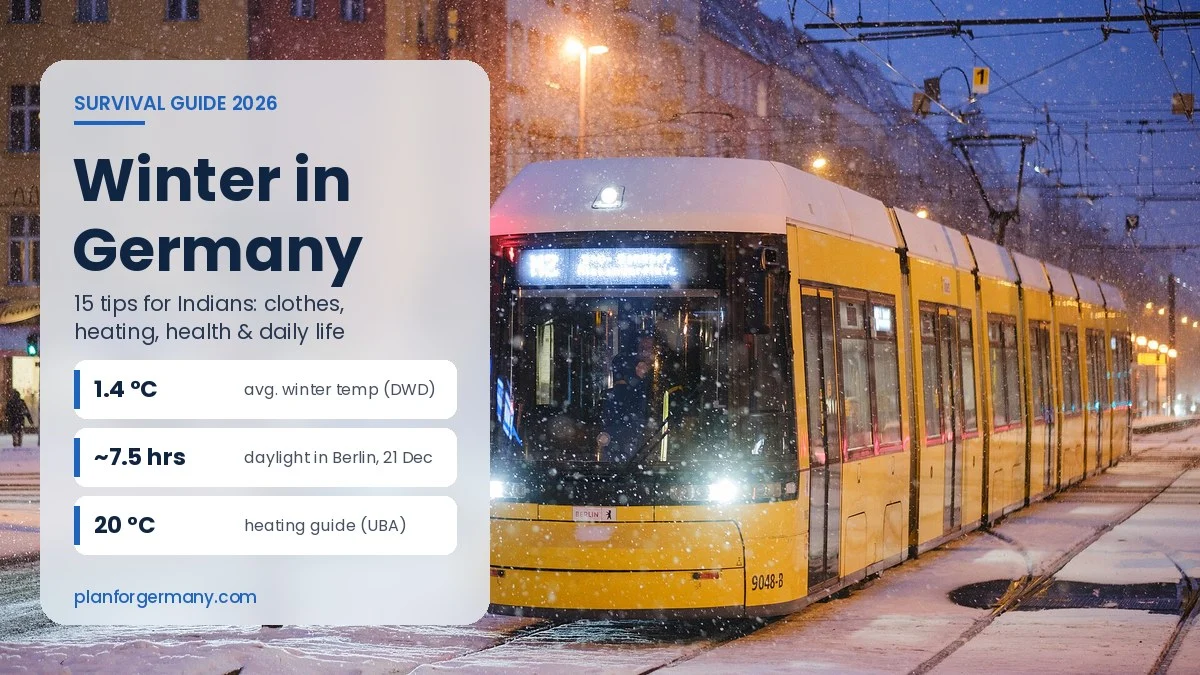
Winter in Germany has arrived early this year. On 20 and 21 November 2026, the German Weather Service (DWD) warned of night frost, black ice and the first snow in the Alps, and northern Germany already measured minus 4 °C on Friday morning.
For many Indians, this is the first real winter of their lives. Short days, icy pavements, heating bills and dry skin can be a shock if you come from Delhi, Mumbai or Bengaluru. This guide gives you 15 practical tips on clothing, heating, health, transport and daily life, so you can enjoy the cold season instead of just surviving it.
Table of Contents
Winter in Germany: Key Facts at a Glance
- Season: roughly December to February, but frost often starts in November and can last until March
- Average winter temperature: 1.4 °C across Germany (DWD reference period 1991–2020)
- Last winter (2025/26): 1.8 °C on average; lowest value −21.7 °C in Oberstdorf on 6 January 2026
- Shortest day (21 Dec 2026): about 7.5 hours of daylight in Berlin and Hamburg, about 8.3 hours in Munich
- Time difference to India: 4 hours 30 minutes (IST is ahead) until clocks change on 28 March 2027
- Recommended room temperature: 20 °C in living areas (Federal Environment Agency, UBA)
- Public holidays: 25 and 26 December and 1 January are national holidays
How Cold Is Winter in Germany?
Winter in Germany is cold, grey and damp rather than extremely freezing. According to the DWD winter report for 2025/26, the average temperature last winter was 1.8 °C, slightly above the long-term average of 1.4 °C for 1991 to 2020. Most days stay between a little below zero and a few degrees above, but cold spells with minus 10 °C or lower do happen, especially in Bavaria and the east.
The weather also changes a lot by region. The Rhine valley and the North Sea coast are usually milder, while the Alps, the low mountain ranges and eastern states such as Saxony get the most frost and snow. Wind on the coast makes it feel colder than the thermometer shows.
| Region (state) | Average temperature, winter 2025/26 | Long-term average (1961–1990) |
|---|---|---|
| North Rhine-Westphalia | 3.8 °C | 1.7 °C |
| Hesse | 2.3 °C | 0.3 °C |
| Baden-Württemberg | 2.2 °C | 0.0 °C |
| Bavaria | 0.9 °C | −1.0 °C |
| Saxony | 0.8 °C | −0.4 °C |
| Brandenburg (around Berlin) | 0.5 °C | 0.1 °C |
For someone from India, even 3 °C feels very cold, especially with rain and wind. The good news: German homes, trains and offices are well heated, so the real challenge is the time you spend outside.
Short Days: Daylight During Winter in Germany
Darkness surprises newcomers more than the cold. After the clocks moved back on 25 October 2026, it gets dark before 17:00 in most cities. Around the winter solstice, the sun rises after 8:00 and sets around 16:00.
| City | Sunrise (21 Dec 2026) | Sunset (21 Dec 2026) | Daylight |
|---|---|---|---|
| Hamburg | 08:34 | 16:01 | about 7 h 27 min |
| Berlin | 08:15 | 15:53 | about 7 h 38 min |
| Frankfurt | 08:22 | 16:24 | about 8 h 03 min |
| Munich | 08:01 | 16:21 | about 8 h 20 min |
Clothing Tips for Winter in Germany
The right clothes make the biggest difference. You do not need expensive brands, but you do need the right layers. Bringing a heavy jacket from India is often a mistake, because Indian winter wear is rarely waterproof. Read our list of things Indian students should carry to Germany to see what is worth packing and what to buy locally.
Tip 1: Dress in Three Layers for Winter in Germany
Germans dress in layers: a thermal base layer (merino or synthetic), a warm middle layer such as a fleece or wool sweater, and a windproof, waterproof outer jacket. Indoors, you simply take off the jacket. Cotton is a poor choice for the base layer because it stays wet when you sweat.
Tip 2: Buy Waterproof Shoes with Good Grip
Wet feet are the fastest way to feel miserable. Buy waterproof boots with a thick rubber sole and a good tread. In icy weeks, cheap slip-on spikes for your shoes help on untreated pavements.
Tip 3: Do Not Forget Cap, Gloves and Scarf
You lose a lot of warmth through your head and hands. A wool cap, touchscreen gloves and a scarf or neck warmer cost little but make walks to the tram stop far more pleasant. For style ideas, see how people dress like a Berliner.
Tip 4: Shop Smart for Winter Wear
Buy your main jacket and boots after you arrive. Department stores, sports chains and discount stores sell good winter clothes, and prices drop in end-of-season sales in January. Second-hand shops, flea markets and online marketplaces are also popular with students.
| Item | Why you need it | Buy in India or Germany? |
|---|---|---|
| Thermal innerwear | Base layer for very cold days | India (cheaper) |
| Wool sweaters / fleece | Middle layer, easy to wash | Either |
| Waterproof winter jacket | Protects from rain, wind and snow | Germany |
| Waterproof boots | Grip on snow and ice | Germany |
| Cap, gloves, scarf | Keeps head and hands warm | Either |
| Lip balm and rich moisturiser | Heated air dries the skin | Either |
Heating and Ventilation: Staying Warm at Home
German flats are heated with radiators, floor heating or heat pumps, and the costs are part of your utilities (Nebenkosten). Your landlord collects a monthly advance and sends a yearly statement. If you used more than estimated, you pay extra. This is why understanding heating is important for your budget during winter in Germany. See our cost of living in Germany guide to plan these costs.
Tip 5: Heat to About 20 °C
The Federal Environment Agency (UBA) recommends a guide value of 20 °C for living areas. Bedrooms can be cooler. Radiator knobs are numbered from 1 to 5; level 3 usually gives around 20 °C. Turning the radiator to 5 does not heat the room faster, it only overheats it later.
Tip 6: Air Rooms the German Way
Germans open the windows fully for a short time instead of keeping them tilted all day. This is called Stoßlüften. The UBA advises airing several times a day, ideally with windows on opposite sides open, and says five to ten minutes are enough in winter. Turn the radiator down while airing. Tilted windows waste heat and cool down the walls.
Tip 7: Prevent Mould
Cooking, showering and drying clothes indoors create a lot of moisture. Cold walls plus humid air lead to mould (Schimmel), which can cause disputes with your landlord. The UBA suggests keeping humidity in poorly insulated flats below 50 percent in winter. A cheap hygrometer helps you check. If you are still looking for a room, our tips on finding accommodation in Germany explain what to check before signing.
- Air the bathroom right after a shower
- Use the kitchen hood or open the window while cooking
- Keep furniture a few centimetres away from outer walls
- Do not let rooms cool down completely, even when you travel
- Report damp spots to your landlord early, in writing
Health Tips for Winter in Germany
During winter in Germany, cold and flu season runs from autumn to spring. Many newcomers catch more colds in their first winter, partly because of crowded trains and partly because their bodies are not used to the cold.
Tip 8: Think About Vitamin D
Your skin makes vitamin D from sunlight, but in Germany the sun is too weak from October to March for enough production, according to the Federal Institute for Risk Assessment (BfR). The German Nutrition Society (DGE) gives 20 micrograms (800 IU) per day as the reference intake when the body makes no vitamin D itself. Many Indians already have low vitamin D levels, so ask your doctor for a blood test before taking supplements.
Tip 9: Fight the Winter Blues
Long dark evenings can affect your mood and sleep. Go outside during daylight hours, even for a 20-minute walk at lunch. Keep a regular routine, exercise, and stay in touch with friends. University counselling services and family doctors can help if low mood lasts for weeks.
Tip 10: Know What to Do When You Get Sick
Register with a family doctor (Hausarzt) early, before you need one. If you work, you usually need a sick note (Arbeitsunfähigkeitsbescheinigung) from the fourth day of illness, but your employer can ask for it earlier. Doctors now send it electronically to your health insurer. Make sure your insurance is active; our article on public and private health insurance explains the options.
- Keep paracetamol, throat lozenges and a thermometer at home (pharmacies are called Apotheke)
- Pharmacies take turns staying open at night and on Sundays (Notdienst)
- Call 116 117 for the medical on-call service outside practice hours
- Call 112 in a medical emergency
Getting Around Safely During Winter in Germany
Tip 11: Watch Out for Black Ice
Black ice (Glätte or Glatteis) is thin, almost invisible ice on roads and pavements. It often forms after rain followed by a clear, frosty night, exactly the situation DWD warned about this weekend. Walk slowly with small steps, hold handrails, and be extra careful on bridges, bike lanes and tram tracks. The free DWD WarnWetter app sends official weather warnings for your location.
Tip 12: Use Public Transport, Plan Extra Time
Trains and trams mostly keep running during winter in Germany, but snow and storms cause delays. Check the DB Navigator app before you leave and allow extra time for exams, interviews or flights. If you travel a lot, the Deutschlandticket is the cheapest option for regional trains and city transport; read our Deutschlandticket 2027 guide before buying.
Tip 13: Driving? Winter Tyres Are Required in Snow and Ice
Germany has a situational winter tyre rule. In black ice, packed snow, slush or frost, cars may only be driven with tyres that carry the Alpine symbol (a mountain with a snowflake). According to ADAC, drivers who break the rule pay a €60 fine and get one point in Flensburg, or €80 if they obstruct others. Also keep an ice scraper and de-icer in the car.
| Situation | What to do |
|---|---|
| Black ice warning | Leave earlier, walk slowly, avoid cycling |
| Heavy snowfall | Check train delays, work from home if allowed |
| Storm warning | Avoid parks and forests, secure balcony items |
| Driving in snow | Alpine-symbol tyres, longer braking distance, lower speed |
Daily Life and Festive Season
Tip 14: Know Your Duties as a Tenant
In many cities, property owners must clear snow and grit the pavement in front of the building (Räum- und Streupflicht), and rental contracts often pass this duty to tenants through a cleaning rota. Check your contract and the house rules. If someone slips because the path was not cleared, the responsible person can be held liable.
Tip 15: Plan Holidays and Enjoy the Season
Christmas is the most important family holiday in Germany. Shops close early on 24 and 31 December and stay closed on 25 and 26 December and 1 January, so buy groceries in advance. Offices and universities often slow down between Christmas and New Year. Use this time to visit German Christmas markets, go ice skating, take a winter hike, or try sledging. If you are a student, the winter break is also a good time to earn money; see our working student guide.
Learning a few German words helps too: Glatteis (black ice), Schnee (snow), Heizung (heating) and Frohe Weihnachten (Merry Christmas). Our list of essential German phrases is a good start.
Winter in Germany Checklist for Newcomers
Use this checklist in your first weeks of November and December:
- ☐ Buy a waterproof jacket, boots, cap and gloves
- ☐ Learn how your radiators and heating costs work
- ☐ Air your flat 2–3 times a day for 5–10 minutes
- ☐ Register with a family doctor and check your health insurance
- ☐ Talk to your doctor about vitamin D
- ☐ Install the DWD WarnWetter and DB Navigator apps
- ☐ Check who must clear snow at your building
- ☐ Stock up on food before 24 December
- ☐ Plan social activities to beat the winter blues
Planning your budget for the cold months? Students should also keep enough money in their blocked account for higher utility costs, and new arrivals can find more settling-in advice in our guide to life in Germany for students.
Frequently Asked Questions
How cold does winter in Germany get?
The average winter temperature in Germany is about 1.4 °C (DWD, 1991–2020). Most days are between slightly below zero and a few degrees above, but cold spells of minus 10 °C or lower can happen, especially in Bavaria, the mountains and the east.
When does winter start in Germany?
Meteorological winter runs from December to February, but frost and the first snow often arrive in November. In 2026, the DWD warned of frost and black ice from 20–21 November.
Does it snow everywhere in Germany?
No. Snow is reliable in the Alps and low mountain ranges, while cities like Cologne, Düsseldorf or Hamburg often get more rain than snow. Berlin and Munich usually see snow on some days every winter.
Should I bring winter clothes from India?
Bring thermal innerwear and a few sweaters, but buy your waterproof jacket and boots in Germany. They are better suited to the wet climate and widely available in sales.
Do I need vitamin D supplements in Germany?
From October to March, the sun in Germany is too weak for enough vitamin D production. The DGE reference value is 20 micrograms per day if the body makes none. Ask your doctor for a test before taking supplements.
What temperature should I heat my flat to?
The Federal Environment Agency recommends about 20 °C for living areas. Air your flat fully for five to ten minutes several times a day to prevent mould.
Conclusion
Winter in Germany can feel long and dark at first, but it is also one of the most beautiful times of the year, with snowy old towns, Christmas markets and cosy evenings. With the right clothes, smart heating habits and a little planning for your health and travel, you will settle in quickly.
Start with the basics: a waterproof jacket, good boots, 20 °C at home and short, intense airing. Then go out and enjoy the season. Bookmark this guide and share it with friends who are spending their first winter in Germany.
Featured image based on a photo by abbilder, licensed under CC BY 4.0 via Wikimedia Commons (cropped, text added).


