

Study Guide Germany is a new, free online platform from the DAAD (German Academic Exchange Service) that helps international students find the right degree programme in Germany and plan every step of the way there. It was officially launched in Berlin on 5 November 2026 and is funded by the German Federal Ministry of Research, Technology and Space (BMFTR).
If you are an Indian student planning a Bachelor’s or Master’s in Germany, this tool can save you weeks of confusion. In this guide, we explain what the platform does, who it is for, how to use it step by step, and how it fits with uni-assist, university applications and your student visa.
Table of Contents
Study Guide Germany: Key Facts at a Glance
- What it is: a free digital study planning platform run by the DAAD
- Funded by: the Federal Ministry of Research, Technology and Space (BMFTR)
- Official launch: 5 November 2026 in Berlin
- Programmes covered: more than 22,000 study programmes at German universities
- Setup time: about 4 minutes to create your personal profile
- Key features: eligibility check, German language assessment, programme search, personal checklist, scholarship info, preparatory courses, DAAD counselling
- Cost: completely free of charge
- Website: study-guide.com (formerly known as My GUIDE)
What Is Study Guide Germany?
Study Guide Germany is a personal study planning assistant for prospective international students. You create a free account, answer a few questions about your education and interests, and the platform recommends degree programmes and universities in Germany that match your profile.
According to the official BMFTR press release, the platform offers individual orientation on more than 22,000 study programmes at German higher education institutions. A personal checklist then guides you step by step through the preparation process and shows which requirements you still need to meet.
The platform also gives you information on scholarships and on ways to prepare for your studies, both in your subject and in the German language. In short, it tries to bring the scattered pieces of the “study in Germany” puzzle into one place.
From My GUIDE to Study Guide Germany
The service is not built from zero. The DAAD announced that Study Guide Germany is the new name of its earlier platform My GUIDE, now redesigned to fit the “Study in Germany” campaign. While study-in-germany.com promotes Germany as a study destination, the Study Guide is meant for the concrete planning part: a personalised programme search based on your own information.
Why the German Government Is Backing It
Germany wants more well-prepared international students, and it wants them to succeed once they arrive. At the launch, Federal Research Minister Dorothee Bär said that international students are a gain for German universities and enrich science and the economy, both during and after their studies.
With Study Guide Germany, we offer young people around the world individual support in choosing a course and preparing for studies at a German university.
Dorothee Bär, Federal Minister of Research, Technology and Space (translated from German)
DAAD President Prof. Dr. Joybrato Mukherjee added that it is not only about how many young people choose Germany, but that they arrive well prepared. Feedback from international students shows that good preparation and realistic expectations are important for success in their studies.
Who Should Use Study Guide Germany?
Study Guide Germany is designed for anyone outside Germany who is thinking about a degree at a German university. It is especially useful if you are at an early stage and do not yet know which programme, city or university type suits you.
- School leavers who want to know if their Class 12 certificate allows them to apply for a Bachelor’s programme
- Graduates looking for a Master’s programme, including English-taught options
- Students who need a Studienkolleg (preparatory course) before they can start a degree
- Scholarship seekers who want to see funding options linked to specific programmes
- Parents and counsellors who want a reliable, official overview instead of agent brochures
German universities also benefit. They can make their international programmes more visible on the platform and get contacted early by qualified applicants. For you, that means a more direct line to the people who actually decide on admissions.
Key Features of Study Guide Germany
Here is what the platform offers, based on the official Study Guide website and the DAAD launch information:
| Feature | What it does for you |
|---|---|
| Eligibility check | A quick, non-binding check of whether your school qualifications let you apply for a Bachelor’s programme |
| Language assessment | Helps you assess your current German level and find language courses |
| Programme search | Explore Bachelor’s and Master’s programmes from over 22,000 options |
| Personal checklist | Step-by-step list of requirements and next actions for your application |
| Scholarships | Shows suitable scholarships for relevant programmes, including DAAD scholarships |
| Preparatory courses | Access to digital courses to prepare for subject-specific requirements from home |
| Contact universities | Send structured questions (for example on financing or admission) to the right university contact |
| DAAD counselling | Book a personal counselling session at selected DAAD locations |
Where the Programme Data Comes From
The DAAD uses two data sources. The first is its own database “International Programmes in Germany”, which mostly lists programmes taught in English with special support for international students. Your search shows these programmes first.
The second source is the Higher Education Compass (Hochschulkompass) of the German Rectors’ Conference (HRK). It is integrated into the platform as a second search and gives a much more complete list of degree programmes, including German-taught ones.
How to Use Study Guide Germany Step by Step
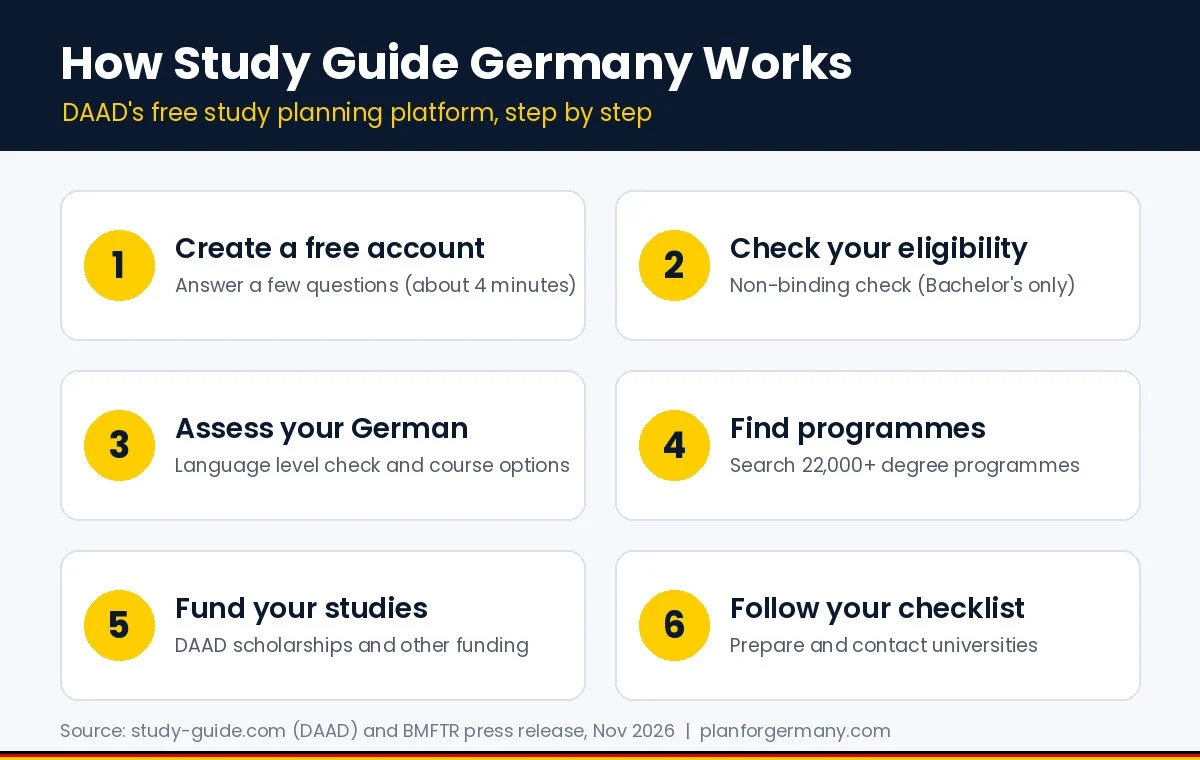
The basic process on Study Guide Germany has three stages: create your account and answer a few questions, get your personal checklist, and prepare your application step by step. Here is how that looks in practice.
Step 1: Create Your Free Account
Go to study-guide.com and sign up. The DAAD says setup takes about four minutes. You will be asked about your background, qualifications and study interests. Keep your marksheets handy so your answers are accurate.
Step 2: Run the Eligibility Check
The eligibility check tells you whether your school qualifications generally allow you to apply for a Bachelor’s programme in Germany. In most cases, you get your result after three or four questions. The result falls into one of four groups:
| Result | What it means |
|---|---|
| General admission | You can apply to any higher education institution for any subject |
| Admission to a specific type of institution | You can only apply to certain institutions, such as universities of applied sciences |
| Subject-restricted admission | You can only apply for a specific field or a limited set of fields |
| No direct admission | You must first attend a Studienkolleg and pass the university qualification exam (Feststellungsprüfung) |
Two points are important. First, the check is only for Bachelor’s programmes; for a Master’s, you must confirm requirements with the university. Second, the result is a guide, not an official decision. The platform uses the Kultusministerkonferenz guidelines published in the anabin database, which most universities and uni-assist also use.
Step 3: Assess Your German Language Skills
Next, the platform helps you assess your German level. Even if you plan an English-taught Master’s, German helps with part-time jobs and daily life. If you need to improve, you can find German language courses through the platform.
Step 4: Find and Shortlist Programmes
Now search for programmes that match your eligibility and interests. Start with the international programmes list, then widen your search with the Hochschulkompass data. If you are an IT student, compare your results with our list of tuition-free Master’s programmes in Computer Science.
Step 5: Check Scholarships and Funding
For each relevant programme, Study Guide Germany shows suitable scholarships. You can search and apply for DAAD scholarships and discover extra funding from universities. Our overview of scholarships to study in Germany lists more options to compare.
Step 6: Follow Your Personal Checklist
Your personal checklist is the heart of the platform. It turns your profile into a to-do list: requirements you meet, documents you still need and next steps. You can also contact universities directly with structured questions or book DAAD counselling where available, and use your profile during that session.
How Study Guide Germany Fits With uni-assist and University Applications
This is where many students get confused. Study Guide Germany is a planning and orientation tool. It does not submit applications and it does not make admission decisions. Universities always decide on admission themselves.
For the actual application, you still apply either directly to the university or through uni-assist, the service that checks international applications for many German universities. Our guide on how to send and track your uni-assist application walks you through that process.
| Task | Study Guide Germany | uni-assist / university |
|---|---|---|
| Find suitable programmes | Yes | No |
| Non-binding eligibility check (Bachelor’s) | Yes | No |
| Personal preparation checklist | Yes | No |
| Scholarship information | Yes | Partly (university pages) |
| Submit your application | No | Yes |
| Official evaluation of documents | No | Yes |
| Admission decision | No | University only |
Not every university uses uni-assist. If you want to skip it, see our list of 20 universities where you can apply without uni-assist. For a full overview of the admission process, read our step-by-step guide to getting admitted to a German university.
Study Guide Germany and Your Student Visa
Study Guide Germany prepares you for your studies and your stay, but it is not part of the visa process. Once you hold an admission letter, the visa steps are the same as before. You apply for a national student visa at the German mission responsible for your place of residence.
In general, you will need your admission letter, proof of financial resources (most students use a blocked account), health insurance, your academic documents and a valid passport. Always check the current list on the website of the German mission in India before your appointment.
- Open your blocked account early. Our guide on opening a blocked account with Fintiba shows each step
- Follow our Germany study visa guide for students from India for documents and interview tips
- Read the 5 steps to apply for a student visa in Germany for a quick summary
- Plan your budget with our article on the cost of living in Germany
Study Guide Germany Tips for Indian Students
India is one of the largest source countries for international students in Germany, so many readers of this blog will use Study Guide Germany soon. These practical tips help you get the most from it:
- Use exact details. Enter your board (CBSE, ICSE or state board), stream and marks exactly as on your marksheets, so the eligibility result is meaningful.
- Understand grade conversion. German universities convert Indian grades with the modified Bavarian formula. Our guide on grade conversion for German universities explains it.
- Plan for the APS certificate. Indian applicants generally need an APS certificate for German university applications and the student visa. The Study Guide does not replace it, so apply for APS early.
- Do not ignore Studienkolleg. If your result says “no direct admission”, a Studienkolleg is your route to a Bachelor’s degree, not a dead end.
- Compare public universities. Most public universities charge little or no tuition. Our list of 35 tuition-free public universities is a good start.
- Use DAAD counselling. The DAAD has offices in India; check in the platform whether counselling is offered near you.
- Start German now. Even A1 or A2 makes daily life, part-time jobs and later careers much easier.
Your Study Guide Germany Checklist
Use this simple checklist alongside the platform:
- ☐ Create your free Study Guide account and complete your profile
- ☐ Run the eligibility check (for Bachelor’s) or check Master’s requirements with the university
- ☐ Assess your German level and book a language course if needed
- ☐ Shortlist 5 to 8 programmes and note their deadlines
- ☐ Check scholarships linked to each programme
- ☐ Apply for APS and get your documents certified
- ☐ Apply via uni-assist or directly to the university
- ☐ After admission: blocked account, health insurance and visa appointment
Limitations You Should Know
Study Guide Germany is a big step forward, but keep its limits in mind. The eligibility check only covers Bachelor’s programmes. Results are non-binding, and some universities apply their own criteria. DAAD counselling is only offered at selected locations. The DAAD also says the free service will be developed further, so expect new features over time.
Finally, it does not cover life after arrival in detail. For that, read our article on the life of international students in Germany.
Frequently Asked Questions About Study Guide Germany
Is Study Guide Germany free?
Yes. Study Guide Germany is a free service of the DAAD, funded by the Federal Ministry of Research, Technology and Space (BMFTR).
How many programmes does Study Guide Germany cover?
The platform offers orientation on more than 22,000 study programmes at German universities, using the DAAD International Programmes database and the HRK Higher Education Compass.
Is the eligibility check an official admission decision?
No. The check is non-binding and only covers Bachelor’s programmes. The university always makes the final admission decision.
Does Study Guide Germany replace uni-assist?
No. It helps you plan and find programmes, but you still apply directly to the university or through uni-assist, depending on the university.
Can Study Guide Germany help me find scholarships?
Yes. For each relevant programme, it shows suitable scholarships, including DAAD scholarships and other funding options from universities.
Can Indian students use Study Guide Germany?
Yes. It is open to prospective international students worldwide, including India. Indian applicants should still plan for requirements such as the APS certificate and the student visa.
Conclusion
Study Guide Germany makes the first and most confusing part of studying abroad much easier. In one free platform, you can check your eligibility, assess your German, search more than 22,000 programmes, find scholarships and follow a personal checklist.
Create your account today, shortlist your programmes, and then move on to uni-assist, APS and your visa with a clear plan. Bookmark this guide and share it with friends who are planning their German study journey.